
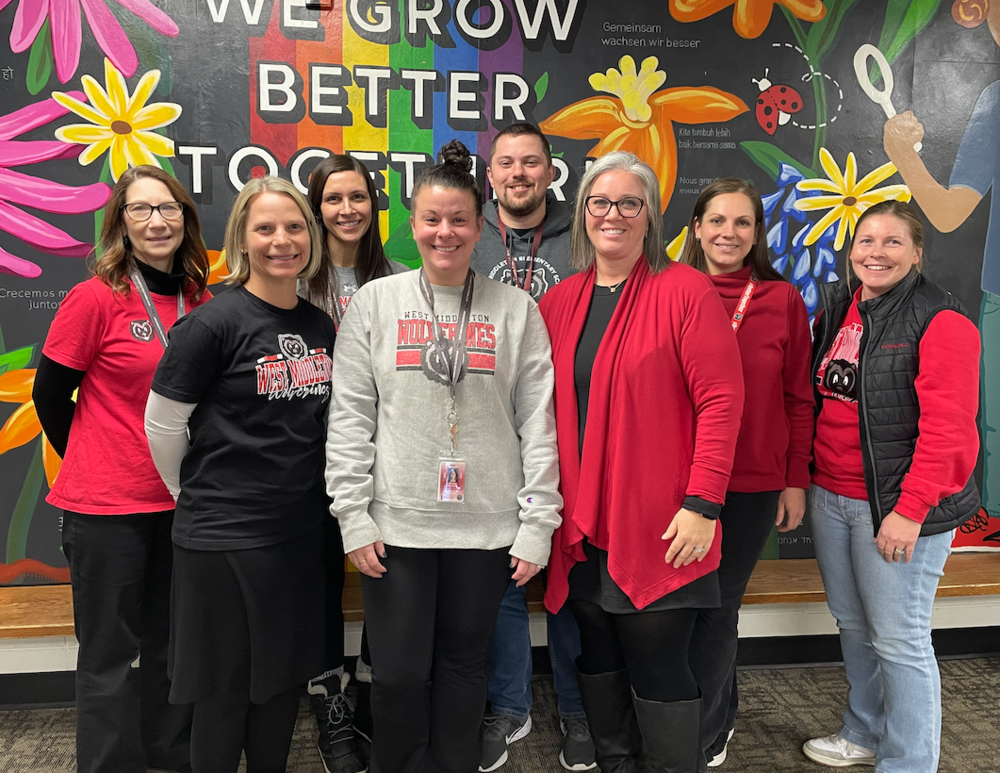
West Middleton Elementary School Principal Mandy Harvey and members of the School Improvement Team (SIT) shared how their school strengthened its score from 78.1 to 86.4 to earn the highest rating of Significantly Exceeds Expectations on the Wisconsin Department of Public Instruction’s annual state reports cards.
A cornerstone of the school’s gains are a focus on foundational literacy skills and a strong commitment to Professional Learning Communities (PLCs), which are groups of educators who collaborate to improve student learning and meet the needs of all learners.
Instructional Coach Erin Lettau said they began focusing on foundational skills standards a few years ago after reviewing school, District, and National Assessment of Educational Progress (NAEP) data.
“We moved our professional development focus to LETRS (Language Essentials for Teachers of Reading and Spelling) training,” Lettau said. LETRS training provides educators with a deeper understanding of the science of reading to strengthen literacy instruction.
“We all had the power and knowledge to make a difference with students,” Lettau said. “We’re all stakeholders – teachers, paraeducators and interventionists – in the work we do with kids every day.”
Lettau said little details they’ve implemented over the years added up to a big impact.
“We used decodables, foundational skills and phonics – and made sure to dedicate time just to foundational skills,” said Jenn Riyeff, who teaches fourth grade. “We’re able to help students develop the skills they need to continue their growth.”
Prioritizing a flex time block within the daily literacy block for students to engage in small groups and/or work independently at their own level also has helped students build their foundational skills.
“Flex blocks give us time for special education teachers and for interventionists to pull kids to give them what they need specifically,” said Jess Daelemans, special education case manager.
Jenessa Anderson, who teaches third grade, said the flex block also allows teachers to “share” students.
“Teachers work with kids from different classes on targeted skills, across grade levels,” Anderson said. “They’re all our students, and it gives us a stronger community feel.”
Harvey said developing a resource hub around foundational skills, with resources for each grade level, has also been key. In addition to the resource hub, colleagues collaborate with one another in the classroom.
“Co-teaching with intervention teachers has been awesome,” Riyeff said. “I spent a week with Reading Specialist Jen Steffen. She modeled lessons for me and sat with me for another week while I taught. She helped me better reach students. Having someone else bring their expertise into my classroom has been a positive experience.”
Improving sense of belonging
The collaboration among staff is among the ways the school has increased a sense of belonging for staff and students. Harvey said a stronger sense of belonging has been critical to strengthening the school’s report card scores.
“It’s about helping students realize that school is important and creating an environment where they want to be,” Harvey said.
Daelemans said their efforts include making sure all students have a strong connection with more than one adult. Jacob Kuehn, who teaches second grade, explained how the Wolverine Dens help students build multiple touchpoints with adults.
“Our Wolverine Dens are a morning-meeting style format. We meet once a month in a small-group setting with students across grade levels,” Kuehn said. “This year our focus is on A Cardinal's Journey, and we focus on a mindset or foundation each month.”
Assigning fourth graders to walk kindergartners to their den meetings also helps students build connections among peers. The school’s efforts to strengthen community ties also extend to parents.
“I’m so impressed with this staff and the amount of communication with parents,” Steffen said.
Steffen noted that teachers work hard throughout the school day to connect with parents in a variety of ways. Lettau added that teachers are grateful for parents’ support of their work, and they also appreciate the efforts of West Middleton’s PTO.
“The PTO makes learning fun for the kids and work fun for the adults,” Anderson added.
Strengthening behavioral support structures
The school’s Responsive Classroom approach, which is a student-centered, social and emotional learning (SEL) approach to teaching, community building, and accountability, is among the ways it’s strengthening behavioral support structures. Special Education Coordinator and Dean of Students Kelly Vetter said teachers review data with their SEL team and use it to guide decisions around behavioral supports.
“Our Student Services Team (SST) looks at individual students’ needs to guide urgency and priorities,” Vetter said. Using data around students’ SEL needs help staff align it with their academic needs.
Riyeff said documenting students’ needs in NextPath, an online platform, also helps staff make data-driven decisions around behavioral supports. She said documenting issues in NextPath helps their colleagues see what approaches have already been tried for a student.
Also, the school has an initiative to set the same behavior expectations for students school-wide.
“Rather than different classes having different expectations, we’ve made it universal for all students in all our spaces,” Daelemans said. “We put plans in place, and we’re being consistent with those”
Kuehn added that teachers are working to be proactive instead of reactive when it comes to behavior expectations. Teachers reinforce expectations by holding students accountable to the Wolverine Way: Let learning happen. Be safe. Show kindness.
Kuehn said they’ve made it more clear for staff on how to ask for extra support with students, and Riyeff said teachers appreciate how responsive their co-workers are to requests for help.
“Our SST will help you problem solve, even if it’s on the fly,” Riyeff said.
Improving behavioral supports is an ongoing part of the school’s larger emphasis on building culture.
“Building connections continues to be a work in progress among partners, teams and staff,” Harvey said. “Stronger relationships lead to more clear communication around behavioral systems and expectations.”
Vetter’s rolling cart in the hallways is one way she’s building relationships.
“Kelly’s visibility, I really appreciate it. I like her presence,” Riyeff said. “I’m not hunting people down.”
SIT members agreed that close relationships are crucial.
“As staff, none of these buckets – foundational literacy skills or behavioral supports – are possible without strong relationships with one another,” Lettau said.
“We have an amazing staff,” Daelemans said. “They care about kids, and they put students first. In our building, you can feel that people genuinely care. It’s such a wonderful place to work. If you're happy, you’re going to do great work.”
“When staff are happier and more connected, we’re even better for kids,” Harvey agreed.
This is the third in a series of articles exploring how MCPASD schools, including Park Elementary School and Glacier Creek Middle School, are strengthening their state report card scores. Learn more about MCPASD’s state report card results.