
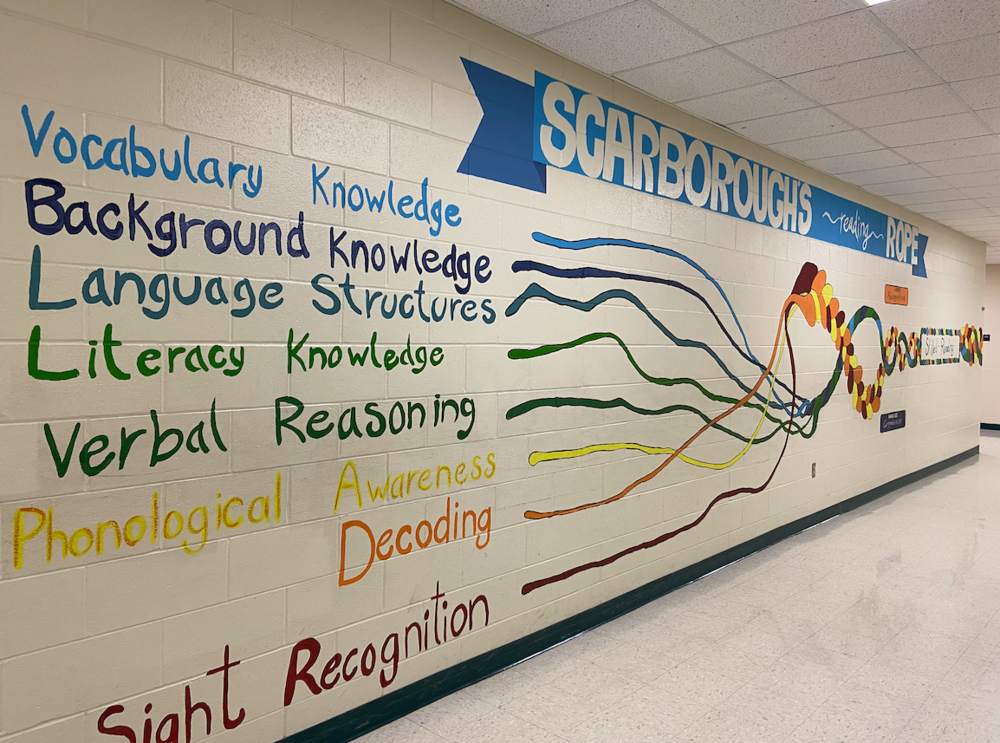
Glacier Creek Middle School is among the MCPASD schools that made notable gains in the Wisconsin Department of Public Instruction’s annual state reports cards, which were released in November. Associate Principal Mary Kern and Instructional Coach Amy Imoehl shared how Glacier Creek Middle School strengthened its score from 84.4 to 87.1, earning the highest rating of Significantly Exceeds Expectations.
Kern said the school’s score has been trending up for five years, thanks, in part, to staff’s consistent focus on literacy.
“All of our professional development in the last five years has been related to literacy accelerators,” Kern said. “We kept returning to the same idea of reading. We were successful because of our teachers and instructional coaches, and the role they played in creating and delivering professional development.”
Imoehl said taking an approach of “we’re all literacy teachers” was critical to getting staff on board.
 “Our first professional development focus was built around vocabulary, and we connected it to science and math too – not just literacy,” Imoehl said. “Coaches were very purposeful with the method with which they connected literacy to all subjects.”
Imoehl explained how their approach to professional development made an impact in the classroom.
“Another component to our intentionality is that students experience similar things in all of their classes; they’re building on literacy skills, with different content, in their next class,” Imoehl said. “The same skills are reinforced throughout students’ days.”
Strengthening Students’ Sense of Belonging
“Every year, our school improvement team and improvement plan has three big rocks,” Kern said.
Glacier Creek Middle School’s key improvement components include:
a literacy goal
an instructional practices goal – i.e., strategies educators can implement to help students learn across the board
a sense of belonging piece
Kern said strengthening students’ sense of belonging has been critical to improving their report card score.
“Data shows the more belonging students feel, the better they perform,” she said.
She said Dr. Dana Monogue emphasized the importance of a sense of belonging for students, inspired by Dr. Doug Bolton’s book Untethered: Creating Connected Families, Schools, and Communities to Raise a Resilient Generation. Kern credited Principal Carmen Klassy as well as educators for setting the tone for the school’s culture of belonging.
“Our teachers are phenomenal humans, not just quality teachers,” Kern said. “We have a lot of natural leaders in this building who work at a high capacity and are kind.”
“It is felt in our building that the people here care about one another – adult to adult, and adult to child,” Imoehl added. “Kids see adults enjoying one another and helping one another; they recognize that too.”
“From a teacher perspective, it’s leaders across the board who value our team,” Imoehl said. “Teachers are ready to step up, and they know if they are asked to do something it’s because they add value and can provide what’s needed. It’s not about someone looking to take over or someone who has all the answers.”
Kern agreed, noting their leadership team “doesn’t pretend to know it all.”
“I feel like because I’m vulnerable, we show up to support one another,” Kern said. “There’s so much strength in vulnerability, and that’s what I convey.”
Building on Their Strengths
 Kern said Klassy’s leadership has been crucial to helping the school maintain their current level of achievement and push for more. This school year, they’re continuing with their literacy accelerators as well as focusing on the new Savvas strategies and curriculum.
One way they’re pushing to accomplish even more is through Tier 2 academic interventions.
Kern explained that Tier 1 refers to about 85% of a school’s population that receives universal instruction, while Tier 3 students represent about 5% of a school’s population that requires extensive support. Tier 2 students are in the middle; they need more support than Tier 1 students but less than Tier 3 students.
Kern worked with instructional coaches and former Glacier Creek Middle School Principal Ken Metz – who now serves as the District’s Director of Secondary Curriculum, Instruction, and Assessment – on a structure targeting Tier 2 students for stronger academic, behavioral, and social-emotional learning interventions and support.
She said they’re already seeing positive results from these interventions. Students’ confidence is growing, including among students with Individualized Education Program or IEPs.
“Teachers have told me, ‘It feels like I’m making a difference,’” Kern said.
Kern said they’ll continue harnessing all of their educators’ strengths to ensure that all students feel empowered to grow into the best version of themselves. Imoehl noted that one of Kern’s gifts is how she brings everyone to the table.
“That’s her super power,” Imoehl said.
This is the first in a series of articles exploring how MCPASD schools are strengthening their state report card scores. Learn more about MCPASD’s state report card results.
Photo: A mural of Scarborough’s reading rope, which illustrates how multiple strands of knowledge and skill intertwine to produce skilled reading, in a Glacier Creek Middle School hallway.