
This article was written for the February edition of the Community Compass newsletter.
The District’s Vision for Teaching and Learning is a framework that outlines key focus areas to guide daily classroom instruction, collaboration and student support. Professional Learning Communities, or PLCs, are at the heart of this vision.
PLCs are groups of educators who collaborate to improve student learning and meet the needs of all learners. They reinforce the foundations of instruction by bringing teachers together with facilitators, instructional leaders and coaches, and social-emotional learning coaches.
Below are three PLC success stories that highlight how this team approach is fostering growth in teaching and learning across MCPASD.
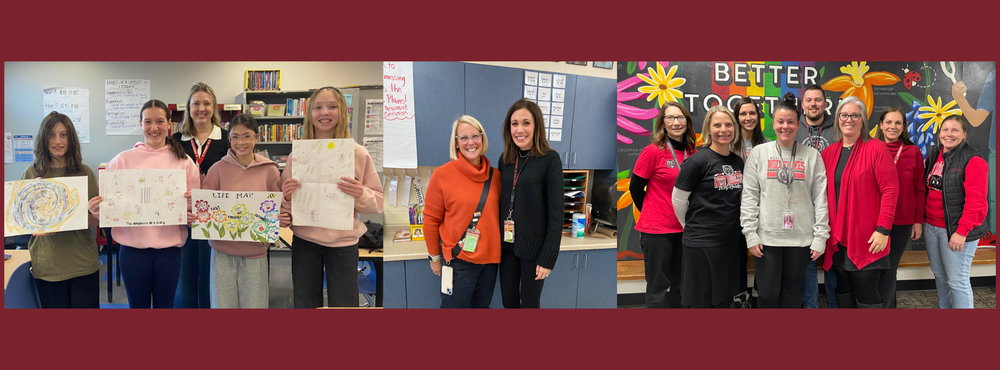
At Park Elementary School, PLCs helped the school achieve a 10-point gain – and earn the highest rating of Significantly Exceeds Expectations – on the Wisconsin Department of Public Instruction’s annual state report cards.
Instructional Coach Jacki Greene and Second-Grade Teacher Caroline Estabrook said PLCs reinforced teachers’ commitment to student-centered learning. Greene said their PLCs have evolved and become more natural.
“We follow a specific protocol, but we’re authentic,” Greene said. “Our PLCs are a ‘get to’ rather than a ‘have to.’ We’re committed to collaboration and to continuing to find ways to improve together.”
Estabrook agreed: “Our PLCs feel more productive because we’ve eased up on trying to fit into a certain protocol. It’s not a check-the-box activity. There’s intentionality in how we approach PLCs, and there’s purpose behind them.”
Greene and Estabrook said PLCs were a key contributing factor to how the school strengthened its state report card scores.
At Kromrey Middle School and Glacier Creek Middle School, PLCs supported teachers’ efforts to connect a Cardinal’s Journey to their academic and career planning (ACP) curriculum.
Eighth-grade literacy teachers Molly Tormey at Glacier Creek Middle School and Jean Holman at Kromrey Middle School worked with their PLCs on integrating a Cardinal’s Journey framework – a guide for student success that outlines the skills, competencies and attributes students should develop by graduation – into their ACP curriculum.
Joanna Cree, associate principal and ACP coordinator at Kromrey Middle School, said the PLCs focused on using milestones life maps, which align with the three components of ACP curriculum – career-readiness standards, life-readiness standards and learn-readiness standards – as well as a Cardinal’s Journey.
“Joanna helped us envision how a milestones life map project could also align with the Cardinal’s Journey mindsets of being self-aware and curious, providing the framework to upgrade our literacy project to a reflective ACP artifact to be uploaded in Wayfinder that could follow students to high school,” Holmen said.
Their team approach was key to discovering how to weave together the milestones life map project with a Cardinal’s Journey and ACP curriculum. Holmen said their work on the integration paid off in helping students realize that planning for their future isn’t a separate subject intended to be studied for only one semester.
Another PLC success story comes from West Middleton Elementary School. Principal Mandy Harvey said the school’s strong commitment to PLCs played a key role in how the school strengthened its annual state report card score from 78.1 to 86.4.
The PLCs reinforced the school’s focus on foundational literacy skills.
Instructional Coach Erin Lettau said they began focusing on foundational skills standards a few years ago after reviewing school, District, and National Assessment of Educational Progress (NAEP) data.
“We moved our professional development focus to LETRS (Language Essentials for Teachers of Reading and Spelling) training,” Lettau said. LETRS training provides educators with a deeper understanding of the science of reading to strengthen literacy instruction.
“We all had the power and knowledge to make a difference with students,” Lettau said. “We’re all stakeholders – teachers, paraeducators and interventionists – in the work we do with kids every day."
Lettau said little details they’ve implemented over the years added up to a big impact.
“We used decodables, foundational skills and phonics – and made sure to dedicate time just to foundational skills,” said Jenn Riyeff, who teaches fourth grade. “We’re able to help students develop the skills they need to continue their growth.”
Harvey said developing a resource hub around foundational skills, with resources for each grade level, has also been key. In addition to the resource hub, colleagues collaborate with one another in the classroom.
“Co-teaching with intervention teachers has been awesome,” Riyeff said. “I spent a week with Reading Specialist Jen Steffen. She modeled lessons for me and sat with me for another week while I taught. She helped me better reach students. Having someone else bring their expertise into my classroom has been a positive experience.”
Across MCPASD, PLCs are strengthening collaboration and enabling educators and staff to more easily share their expertise – all to better meet the needs of all learners.