
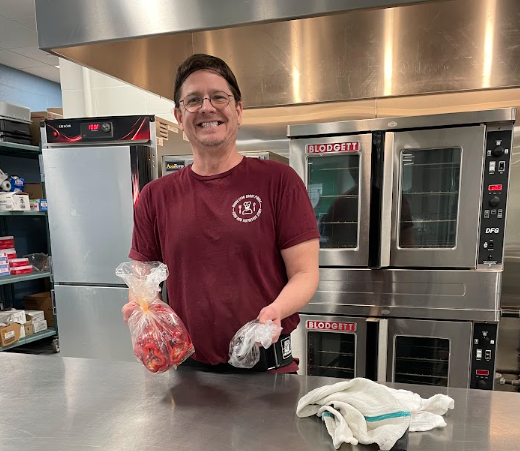
Pope Farm Elementary School Head Cook Cliff Curtis has implemented several sustainability measures to save money and reduce waste in the school’s cafeteria. It started with a silverware problem.
“We were losing silverware left and right,” Curtis said. “On an average day, we served 250 students and I would pull 75 pieces of silverware out of the trash. At 40 cents a piece, that adds up to $25-30 a day in silverware.”
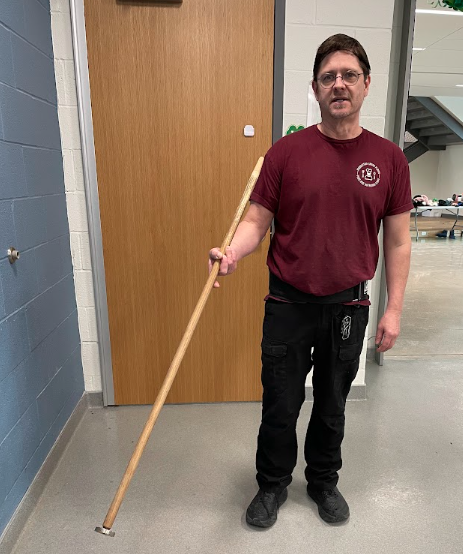 In addition, Curtis spent about 15 minutes each day fishing silverware out of garbage cans with the special tool he made: a handle with a magnet attached to the bottom.
Curtis has worked in the restaurant industry since he was a teenager, and he knew there was technology available to resolve the issue. He talked with MCPASD Food and Nutrition Supervisor David Montag about trash can toppers that have magnetic bars to attract and hold metal flatware.
The lids help cafeterias minimize loss and reduce waste. Curtis and Montag decided to make Pope Farm’s cafeteria a pilot program for the District.
In November, Pope Farm Elementary School bought two toppers, which cost about $179 each.
Curtis said the new toppers catch about 95% of the silverware, making the initial investment worth it.
“At $179 per lid, that’s a week’s worth of silverware paid for,” Curtis said.
The new lids have saved Pope Farm Elementary School significant money and time, and it’s just one of the sustainability measures Curtis has implemented.
“I have cut plastic and paper use here almost to zero,” he said.
He accomplished this by replacing the paper boats used to serve breakfast with reusable trays and eliminating the use of plastic silverware.
“I only use the paper boats now for students who are running really late at breakfast,” Curtis said. “We’re down from 80 boats every day to three to five. I wash 80 extra trays a day, but that’s not a big deal.”
He said that multiplied over the course of the year, using fewer paper boats and eliminating plastic silverware is a substantial waste reduction.
“What this school must have put into a landfill every year with plastic forks and knives alone would be 1,500 per week,” Curtis said.
He’s proud of his efforts to reduce the cafeteria’s reliance on paper and plastic disposables.
“I don’t think it’s necessary,” he said. “It’s bad for the planet and bad for business.”
Montag said that Pope Farm’s pilot program with the trash can toppers has been so effective that the District is expanding it to all of its elementary schools.
"Seeing the immediate return on investment at Pope Farm made the decision to expand easy,” Montag said. “By scaling these sustainability measures to all our elementary schools, we aren’t just saving thousands of dollars in replacement costs, we’re teaching our students that small, operational changes can have a massive impact on our environment."